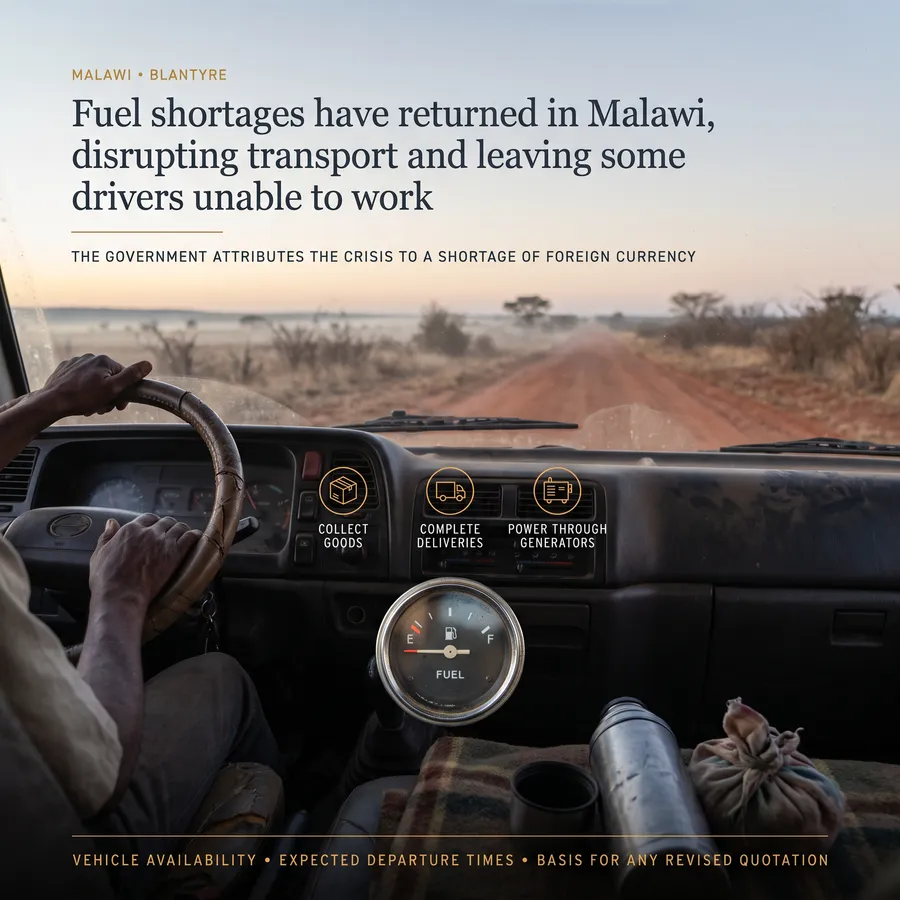
"Fuel shortages have returned in Malawi, disrupting transport and leaving some drivers unable to work. Reuters reports that motorists in Blantyre were sleeping at filling stations while waiting for supplies, with the government attributing the crisis to a shortage of foreign currency. The disruption is commercially relevant beyond passenger transport. Businesses depend on fuel to collect goods, complete deliveries and, in some cases, maintain power through generators. Uncertain availability can affect the timing and cost of those activities.
The report does not establish a firm date for normal supply to resume. Buyers and suppliers should therefore base commitments on current operating information rather than an assumed recovery. For companies trading with Malawi, a first step is to confirm the status of planned shipments with their logistics partners. That discussion can cover vehicle availability, expected departure times and the basis for any revised quotation.
Customers may also need clearer updates on goods already in transit. A realistic delivery estimate is more useful than a timetable that no longer reflects conditions on the ground. Suppliers can review which orders are most sensitive to delay and communicate changes before they create problems for the buyer’s own operations. Perishable products and time-critical production inputs may require particular attention.
The shortage illustrates how currency constraints can become a physical supply-chain problem. Monitoring payment conditions alone is insufficient when transport capacity is also affected. For buyers, the priority is dependable communication and realistic scheduling, supported by verified information from the businesses responsible for each delivery stage."